
Dearly Beloved in Yeshua,
Focus on the Female
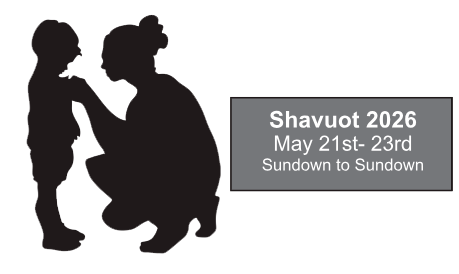
There are two special days in May 2026: Mother’s Day on May 10th, and Shavuot—or Pentecost—on May 21st. As I pondered the possible connection between the two holidays, I arrived at a “Spirit” and “female” connection.
Mother’s Day celebrates women who have given birth or otherwise raised and nurtured children. I learned many years ago that giving birth is not the only way to be a “mother.” Married fourteen years before I gave birth to my first child, I “mothered” a number of people spiritually, including the little children in my preschool and kindergarten classes. Then, like other women, I was also a “Mother in Israel” as the Bible says of the prophetess/judge Deborah: “Village life ceased, it ceased in Israel, until, I, Deborah, arose, arose a mother in Israel” (Judg. 5:7). In my opinion, soul winners and intercessors are among those women whom God sees as “mothers in Israel.” Ultimately, a mother is a woman who loves and nurtures others—like many of you.
What about Shavuot, fifty days after Passover, (eve of May 21 – eve of May 23, 2026), which commemorates the giving of the Torah (the Word of God) on Mount Sinai? God-incidentally, the Ruach HaKodesh was given to the first followers of Yeshua the Messiah on this special pilgrim feast. (Acts 2, the Upper Room.) God’s Word and God’s Spirit. A female connection? Psalm 68:11 is fulfilled many times in the New Covenant Scriptures. Two translations are: “The Lord announces the word, and the women who proclaim it are a mighty throng” (NIV) and “The Lord gives instructions. The women who announce the good news are a large army” (GW). The WORD was given on the outside on Mt. Sinai. It went from tablets of stone to tablets of the human heart on Mt. Zion, through the Ruach HaKodesh. When Yeshua rose from the dead, He first appeared to two women. And it was Mary Magdalene who first proclaimed the great news of His resurrection.
The Bat Kol: A Spirit Connection
On the Day of Pentecost, the disciples heard a sound from heaven, as of a rushing mighty wind. Ruach is the Hebrew word for wind or spirit. They commented, “How is that we hear, each in our own language in which we were born?” (Acts 2:8). This same idea, of a divine voice, has a name in traditional Judaism. It is called the Bat Kol בת קול (BAHT KOHL), literally the “daughter of a voice.” A heavenly voice that announces God’s will, judgment, or important information is female.
The concept of the Bat Kol emerged at the end of the prophetic era and was considered to be an “echo” of the supreme divine voice rather than the direct voice of God Himself. Nevertheless, the Bat Kol was seen as the way that God chose to guide human affairs after the prophets died out. This is mentioned repeatedly throughout the Talmud.
The Bat Kol is sometimes identified today with the Holy Spirit and thought to be the “still small voice” that Elijah heard in I Kings 19:12-13. Bat (daughter) Kol (voice) makes a decidedly sweet, spiritually sensitive, feminine statement.
Women in Bible Times
Women in Bible Times lived challenging lives, void of many of the luxuries that we have today. They focused on domestic duties, helping with agriculture and child rearing. Their value was sometimes directly tied to their ability to bear children. Barrenness was viewed as a severe hardship or even a curse. (Consider the anguish of Hannah in I Samuel 1:8-11 or that of Rachel in Genesis 30:1-2).
Living in a patriarchal society, women were restricted from full participation in Temple worship—limited to the outer court, the Court of the Women (Ezrat Nashim, , עזרת נשים ehz-RAHT nah-SHEEM). Women were generally prohibited from studying the Torah, considered to be the duty of men.
Nevertheless, Jewish women had a more elevated status than the women in the surrounding nations. They had VALUE. That is why they had to be purchased. A MOHAR, BRIDE PRICE, was paid for a Jewish bride. The prospective bridegroom paid the price to the bride or her parents. It served as a type of protection for the woman, in the event of divorce or death of her husband. (Consider the price that Yeshua paid for His bride: I Peter 1:18-19).
The mohar led to the development of the KETUBAH or marriage contract which is still part of Judaism today. The ketubah began as a private arrangement between families but then evolved into a legal document safeguarding the wife’s financial security, especially in cases of divorce or death. The KETUBAH was all about protecting women! It outlined the obligations and the responsibilities of the bridegroom for the bride. It was, in fact, a protection of women’s rights and their material and emotional needs. The ketubah provided a woman a measure of security rare in ancient societies and helped elevate the status of married women within the Jewish community.
Today, the ketubah has evolved but still remains a central element of Jewish weddings. It is a legal formality and a personalized expression of love. (The bride of Messiah has a ketubah today as well. It’s called the Holy Bible and contains promises of provision and blessing for Yeshua’s bride!).
Yeshua and Women
Yeshua interacted with women in a way that both broke traditional and cultural taboos and elevated their status. He did not see women as inferior or unclean in any way. He treated women with respect and even chose women to be His disciples. He spoke to women in public, including foreigners, and consistently showed compassion to women of every age and status in society. WOW! That’s a Messiah worthy of our love and devotion!
Yeshua’s disciples were shocked to find him speaking with a Samaritan woman at a well. A woman! A foreigner! She was shocked as well and said, “…‘How is it that You, being a Jew, ask a drink from me, a Samaritan woman?’ For Jews have no dealings with Samaritans” (Jn. 4:9). Yeshua revealed Himself as the Messiah to this woman. He crossed all boundaries.
Then there was the woman with the issue of blood. According to society and Jewish law, she was unclean. Untouchable. Her story is told in three of the four Gospels: Matthew 9:20-22, Mark 5:25-34, Luke 8:43-48. “And suddenly, a woman who had a flow of blood for twelve years came from behind and touched the hem of His garment. For she said to herself, ‘If only I may touch His garment, I shall be made well.’ But Yeshua turned around, and when He saw her He said, ‘Be of good cheer, daughter; your faith has made you well.’ And the woman was made well from that hour” (Matt. 9:20-22).
When the woman touched Yeshua, He should have been made unclean. Instead, she was made clean. The Messiah honored her faith (He appreciates the faith of women). He even called her “daughter” (Luke 8:48). Such love and compassion. (We don’t know if she was aware that touching His tzitzit, fringes, put her in contact with the authority of the Living Word of God who has healing in His wings [kanfot כנפות kahn-FOHT]!) And the healing happened while the Messiah was on His way to heal the daughter of Jairus. He raised the little girl from the dead. (Matt. 9:24-25).
What about the woman caught in the act of adultery? Another miracle of grace. (Jn. 8:1-11) The scribes and Pharisees brought her to Yeshua, expecting Him to agree to stoning her according to the Law of Moses. (They were testing Him.) He wrote something in the earth, and said to them, “…’He who is without sin among you, let him throw a stone at her first'” (v7). They all left, being convicted by their conscience. The religious leaders condemned her. Yeshua forgave her, and said, “…’Go and sin no more'” (v11). A shocking defense of a sinner—a woman!
When a Canaanite woman cried out to Yeshua for mercy, distressed over a severely demon-possessed daughter, He responded with kindness and compassion even though His disciples urged Him to send her away. Yeshua was moved by this woman’s faith, saying, “…’O woman, great is your faith! Let it be to you as you desire’…” (Matt. 15:28).
Many of Yeshua’s healing miracles involved women. Peter’s mother-in-law was sick with a fever. The Messiah touched her hand, and the fever left her. (Matt. 8:14-15) There was a woman who had a spirit of infirmity eighteen years and was bent over, unable to raise herself up. “And behold, there was a woman who had a spirit of infirmity eighteen years, and was bent over and could in no way raise herself up. But when Yeshua saw her, He called her to Him and said to her, ‘Woman, you are loosed from your infirmity.’ And He laid His hands on her, and immediately she was made straight, and glorified God” (Luke 13:11-13). This healing occurred on Shabbat and angered the ruler of the synagogue.
Yeshua called him a hypocrite and defended what He had done, saying, “‘So ought not this woman, being a daughter of Abraham, whom Satan has bound—think of it—for eighteen years, be loosed from this bond on the Sabbath?'” (Luke 13:16). The title “daughter of Abraham” was a title of dignity. Yeshua saw this woman as having equal worth as a “son of Abraham”.
Yeshua also had women as friends and disciples (Mary and Martha). To sit at the feet of a rabbi, as Mary did, meant that a person was one of his disciples. Women supported His ministry (Joanna and Susanna). And of course, His mother Miriam (Mary) was dear to His heart. Right before saying “It is finished” on the cross, Yeshua expressed the desire for His mother to be cared for. He said to her, “…’Woman behold your son!'” and to John, the beloved, “…’Behold your mother!’ And from that hour that disciple took her to his own home” (Jn. 19:26-27).
Honor Thy Mother
The biblical command to honor one’s mother is first found in the Holy Scriptures in Exodus 20:12, “Honor your father and your mother, that your days may be long upon the land which the Lord your God is giving you.” Ephesians 6:2 says, “‘Honor your father and mother,’ which is the first commandment with promise”.
There has always been a special kind of reverence in the Jewish tradition for one’s “mother,” ima in Hebrew אמא (EE-mah). I married a Jewish man. His mother was from Poland, a sweet, loving “yiddisha mama” who Neil called “Mamushka.” I saw the love they had for one another, as well as her deep desire for his happiness. I also heard her instruct him concerning his responsibility to make me, his wife, happy. If you have ever heard the song “My Yiddishe Momme,” the much valued quality of selflessness of Jewish mothers stands out. Jewish mothers are known for putting the happiness and well-being of their children above their own. Children are still commanded to honor their mother even if she takes her mothering to the extreme and might be over-bearing, over-protective, or controlling. Love is still the motivation of the heart.
Mothers are honored in Jewish homes today every Friday night as Proverbs 31 is recited and the woman of the home is considered an Eishet Chayil, אשת חיל (eh-SHEHT KHAH-yeel), a woman of valor. She ushers in the Sabbath with the lighting of candles and joins her husband in blessing their children. Girls are blessed with, “May God make you like Sarah, Rebecca, Rachel, and Leah” (the four revered matriarchs of the Jewish faith). “Yesimech Elohim k’Sarah, Rivka, Rakhel v’ Leah.” ישימך אלהים כשרה רבקה רחל ולאה
The qualities mentioned in Proverbs 31 that are valued in Jewish women include strength, wisdom, dignity, faith, and resourcefulness. The woman of Proverbs 31 does not only occupy herself with household duties. She is a dynamic force in business, community leadership, charitable works, and has an entrepreneurial spirit.
Mothers, in Judaism, are also seen as partners with God. They are revered as the foundational transmitters of Jewish identity and the primary nurturers of a child’s soul. This unique, essential role of the mother in a child’s life is largely based on the belief, according to Jewish law, that a child born to a Jewish mother is considered Jewish. (This means that Jewish Law dictates Jewish identity.) Since I am not Jewish by birth, my two sons would not be considered Jews in Israel, even though their father was Jewish. However, biblically, they would be considered Jewish. Jonathan and Jesse are the sons of Nahum ben Ariah (Neil the son of Harry Lash). Look at the biblical genealogies. Patrilineal.
God’s Heart for Women (and Mothers) Today
The heart of God is saddened today about the oppression of women under radical Islamic law.He longs for them to be set free. As the war with Iran continues, the reality of life under Sharia Law (in Iran and throughout the Middle East) is being exposed as never before.
While not all Muslims are radical Muslims, Islam as a religion oppresses women. A worker in our local Walmart is covered with black from head to toe. All that is visible are her eyes. She obviously has a job—at the service desk—earns money and has a measure of freedom. But this can not be said of all Muslim women. Their religion, Islam, literally means “submission.” Not the kind spoken of in the New Covenant in Ephesians 5:22, where wives are exhorted to submit to their own husbands, as to the Lord. In the true, biblical context, this is a submission that is a response to love—not fear. Not force. Not threats of punishment. The wife of a Messianic Jew or Christian man is supposed to experience the same kind of love that Yeshua has for His bride—self-sacrificing, protective, unconditional, and unchanging.
Muslim women live under Sharia Law, which is derived from the Qur’an, and is concerned with personal religious observances. Sharia Law is followed in Iran and other Arab countries. It has reached the shores of Europe (notably London) and the U.S. (notably the state of Michigan).
Behavior under Sharia is legislated. Women are subject to mandatory modesty laws such as wearing a hijab or veil. Non-compliance results in punishment. Women are required to obey their husbands in a “reasonable manner” and must obtain permission from male guardians to leave the house, marry, divorce, or have custody of their children. A husband’s financial support, including clothing and food, is contingent on a wife’s “obedience.”
The legal age of marriage in Iran is 13, and girls can be married even younger if their male guardian deems it appropriate. In many countries, like Afghanistan, women experience forced marriage, child marriage, and honor killings—where individuals are murdered due to perceived damage to a family’s honor (e.g., conversion to Christianity).
I can’t imagine a “Mother’s Day” in Muslim countries. Women, under Sharia Law, need Yeshua! They need freedom—physical and spiritual. They need the only One who can set them free and give them a hope and a future: The Messiah.
We are seeing in our day a real spiritual battle between the God of Islam, Allah, and the God of the Bible, the God of Abraham, Isaac, and Jacob. Europe seems to have rejected Jacob and embraced Esau. What will the U.S. do? New York City may be an ominous foreshadowing.
I encourage everyone to pray that our country will hold fast to our Judeo-Christian ethic as we approach our 250th anniversary. PRAY for women under Sharia Law—that Yeshua will continue to appear to them in dreams and visions. And then, may God grant them the courage and strength to leave darkness and enter into the Lord’s marvelous light.
God’s Love for Women and all Mothers is boundless.
Receive that love today, my sisters!





You must be logged in to post a comment.