



Blessings as we enter 2026,
The Gospel in 2026
Let’s make 2026 the year to focus on the Gospel! May the truth of Romans 1:16 be made flesh in each of our lives: “For I am not ashamed of the gospel of Christ [Messiah], for it is the power of God to salvation for everyone who believes, for the Jew first and also for the Greek [Gentiles].” Words connected with “gospel” are “power,” “salvation,” “believes,” “Jew,” and “Gentile.”
Another way to say “gospel” is “good news,”—the very Good News that God sent His Son, Yeshua, into the world to save mankind from their sin and give them abundant life, now and forever. The Father’s goal has always been to get the gospel TO US and then THROUGH US.
The word Gospel is found 98 times in the New Covenant. Its understanding is crucial to understanding the Bible. First of all, the gospel always begins with God—His reaching out to all of humanity, desiring relationship with them. God has a good plan, a hope, and a future for every human being. He is the love and peace that people are searching for but do not find apart from Him. Sin blocks the relationship between a Holy God and unholy people. Self, not God, is king of our lives.
God, in His great love, sent His Son, Yeshua the Messiah, to be the eternal sacrifice for sin for all time. As we recognize our own sin, decide to turn from it, and receive God’s forgiveness through His Son, we become part of God’s family and a new life begins for us. We find the purpose for which we were born—our divine destiny.
The Jewish Root
The concept of the gospel is first found in the Tanakh (Old Covenant) as well as in the writings of the ancient rabbis. One rabbi actually said, “How beautiful is King Messiah, bringing the gospel to Israel!” The prophet Isaiah foretold that the Messiah would one day come to Israel and “basar:” “The Spirit of the Lord God is upon Me, because the LORD has anointed Me to preach good tidings [basar] to the poor; He has sent Me to heal the brokenhearted, to proclaim liberty to the captives, and the opening of the prison to those who are bound” (Is. 61:1). The Hebrew word basar בשר (bah-SAHR) is related to besorah בשורה (beh-soh-RAH), its noun form meaning “flesh.” Think about it. The good news or gospel prophesied by Isaiah would be related to “flesh.” Yeshua came in the flesh. “And the Word became flesh and dwelt among us, and we beheld His glory as of the only begotten of the Father, full of grace and truth” (Jn. 1:14). The Messiah repeated the verse from Isaiah in Luke 4:18, using the word “gospel” instead of “good tidings,” explaining that the Scripture was being fulfilled in their hearing that day—in Him!
The Gospel of the Kingdom
The first mention of the gospel in the Brit Hadasha is found in Matthew 4:23, “And Yeshua went about all Galilee, teaching in their synagogues, preaching the gospel of the kingdom, and healing all kinds of sickness and all kinds of disease among the people.” Matthew 24:14 says, “And this gospel of the kingdom will be preached in all the world as a witness to all the nations, and then the end will come.”
I have come to realize that the Gospel of the Kingdom is even more than the Gospel of Salvation.Yes, the Gospel of Salvation shows us how to enter into heaven, but the Gospel of the Kingdom is about getting heaven into us, as we follow a King who asked us to join Him in a Kingdom adventure. Both are crucial. One leads to the other. The Kingdom of God (Kingdom of Heaven) was a major focus of Yeshua’s teaching, referring not only to a future era of universal peace established by God on earth, but the Kingdom of God NOW in the lives of His followers. Consider Mark 1:14-15, “Now after John was put in prison, Yeshua came to Galilee, preaching the gospel of the kingdom of God, and saying, ‘The time is fulfilled, and the kingdom of God is at hand. Repent, and believe in the gospel.'”
Once we repent and believe in the gospel, we have a role to play in God’s Kingdom on earth, which is here now. Yeshua taught His talmidim to pray, “…Our Father in heaven, hallowed be Your name. Your Kingdom come. Your will be done on earth as it is in heaven” (Luke 11:2). They were part of bringing in His Kingdom, preaching the Gospel of the Kingdom as commanded: “And heal the sick there, and say to them, ‘The kingdom of God has come near to you'” (Luke 10:9; see also Matt.10:6-8). Let’s do this in 2026 before Messiah returns to earth for His bride.
Sharing the Gospel or Good News
There are numerous ways to share the gospel, depending on the one sharing and the one receiving. The important thing is to be led of the Holy Spirit in your gospel conversation. A classic gospel presentation is called the “Romans Road.” This takes less than three minutes. It’s always good to begin with a question: e.g. “Have you ever heard of the gospel?” “Do you understand it?” While “Romans Road” usually begins with the problem of “sin,” I prefer to begin with the fact that there is a living God who wants to have a close relationship with us. Then…
- Address the problem of sin (Rom. 3:23)
- Explain that the consequence of sin is death (Rom. 6:23)
- Share about God’s Love in sending His Son to die for our sin (Rom. 5:8)
- Confess Yeshua as Savior and Lord and believe that God raised Him from the dead (Rom. 10:9)
The Gospel in Five Minutes: The Three Circle
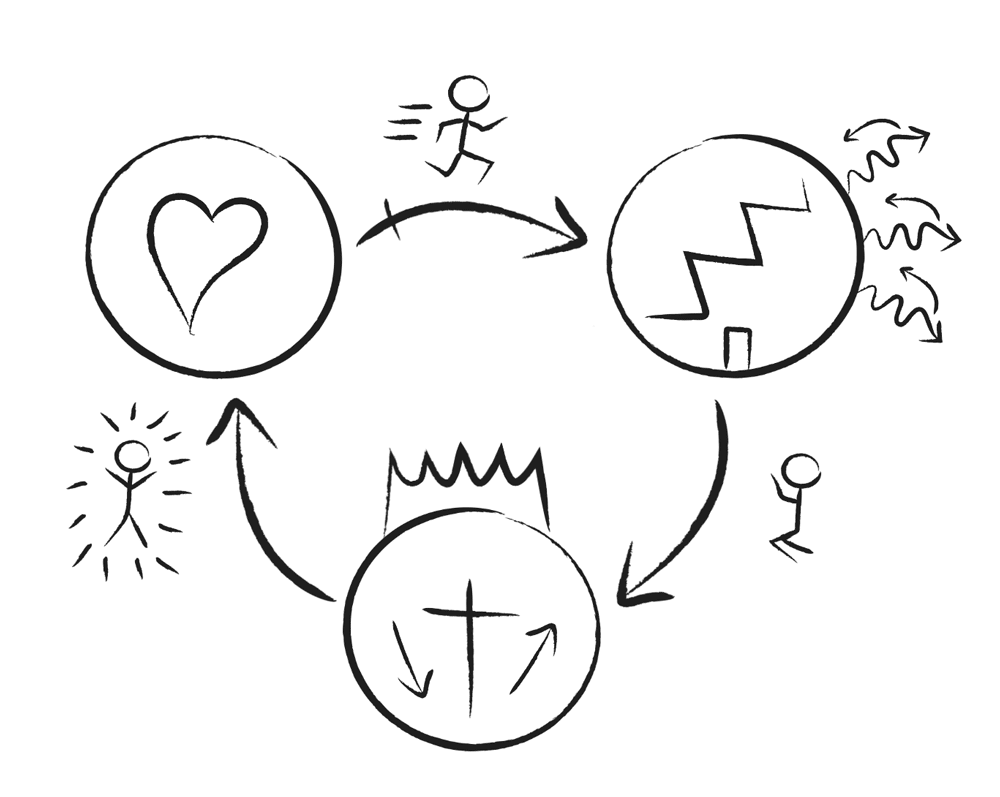 This Gospel presentation, first developed by Jimmy Scroggins of Family Church, is a bit more lengthy but good for visual learners. You can draw the circles one at a time and explain. First, God’s original perfect design is a world full of love, joy, unity, and peace
(shalom). But today our world is broken—Examples: war, disease, poverty, addictions, wrong values. The cause of our brokenness is “sin.” We have turned away from God’s way and try various ways to heal or escape our brokenness. Examples: alcohol, money, relationships, shopping, pornography. None fix the problem.
God doesn’t want us to stay in brokenness—or be separated from Him. He sent a solution—His Son, Yeshua the Messiah, to cancel our sin by His death. But not only did He die, He rose from the dead after three days—and God made Him King of everything in heaven and earth.
When we repent, turn from sin to God—and believe in Yeshua and what He did for us—God raises US up to walk in newness of life as a part of His family. We model this new life in a broken world. Our new mission is to go back into the brokenness of others and help them find life and freedom.
There are 2 kinds of people: 1) Those living out God’s rescue mission, and 2) Those still in brokenness, needing to be rescued. Which are you? Where do you want to be? What is holding you back?
The Gospel Message from the Tanakh
When my husband Neil and I were young believers, we took a course developed here in Ft. Lauderdale by Dr. D. James Kennedy called “Evangelism Explosion.” It was a gospel presentation that largely focused on showing people how to get to heaven when they die—an effective Gospel of Salvation message that the Lord used to bring many souls into His Kingdom. Once we began TAK, a Messianic synagogue, I realized that Evangelism Explosion was not culturally appropriate for Jewish people. “Christ,” for example, is a term linked to thousands of years of persecution. “Messiah” is softer and more Hebrew-friendly. So I endeavored to rewrite the Evangelism Explosion program with only verses from the Tanakh, the Old Covenant.
God, Man, and the Holy Scriptures
1. God: loves man; is Holy
Why did God create us? (Is. 43:7,10) What does God expect of us? (Deut. 6:3-5)
2. Man: sins; is separated from God
Is man basically good? (Psalm 53:2,3) How does our sin affect God? (Isaiah 59:2)
3. Good Deeds: not enough for God (Faith is)
How does God see human efforts to achieve righteousness? (Is. 64:6) What made Abraham righteous? (Gen. 15:6)
4. Atonement: “At-one-ment” with God
What is atonement in the Torah? (Lev. 17:11) What did the Jewish High Priest do? (Lev. 16:15)
5. Messiah: The Suffering Servant
Was the Messiah’s death foretold? (Is. 53:3-12) Was Messiah God’s Son? (Prov. 30:4)
6. Faith: in Messiah’s atoning death
What attitude of heart does God desire? (Ps. 51:6-10,17) What does God promise us? (Is. 1:18)
7. New Beginnings: Eternal life begins now
What are the benefits? (Jer. 31:10-14) What did God say about the New Covenant? (Jer. 31:31-33)
The Five Jewish Laws
This gospel presentation was developed by the late Manny Brotman. I am including it in shortened form, to give you another Jewish-friendly option.
Law 1: The God of Abraham, Issac, and Jacob created you to have a personal relationship with Himself, and to enjoy His abundant life. (Prov. 16:4)
Law 2: Sin (the transgression or breaking of God’s Law) separates you from a personal relationship with God and His abundant life. Sin also causes spiritual death. (Is.59:2; Ezek. 18:20)
Law 3: You cannot remove sin by your own human efforts. (Is. 64:6; Prov.14.12). Sin can only be removed by faith (believing what God says) (Gen. 15:6). Faith must be placed in the blood of atonement. (Lev. 17:11)
Law 4: God has provided the blood of atonement through the perfect sacrifice of the Messiah, the “Anointed One.” (Is. 53.5) Yeshua fulfilled the prophecies of the Jewish Messiah in the Jewish Bible (e.g. Micah 5:2; Is. 53:3,8; Psalm 22:15-18)
Law 5: You must ASK Messiah Yeshua into your heart and life in order to have the blood of atonement, a personal relationship with God, and enjoy His abundant life. (Joel 2:32) When Messiah Yeshua knocks on the door of your heart, you have three choices… “Go Away,” “Don’t Answer,” or “Come In.”
A Sample Prayer: “Dear God, I confess that I have sinned against You, and I am truly sorry for it. I now invite Messiah Yeshua into my heart and life to cleanse me with His blood of atonement. Thank You for doing this according to Your Word. Please help me to live a life pleasing to You from this time forward. In Your Name, AMEN.”
“Good News” vs. “Bad News” in One Verse
Most of the world is familiar with John 3:16, “For God so loved the world that He gave His only begotten Son, that whoever believes in Him should not perish but have everlasting life.” This is the Gospel in ONE VERSE.
The Good News is that God is Love and a Giver who loves everyone with unconditional love. The Bad News is that everyone sins which results in spiritual separation from God now and eternally. The even better news is that God sent His only Son, the Messiah, into the world to take our place and die for our sin. Our choice is to believe in God’s great Gift. When we repent of our sin and put our trust in Him, we receive His promise of eternal life with God and abundant, purposeful life here on earth.
Gospel vs. “Godspell”
Some of you may remember an Off-Broadway musical, “Godspell,” popular in 1973, the year I came to know the Messiah. The secular production was a musical retelling of the Gospel of Matthew, set in modern-day New York City. The show was seen by believers as irreverent, shallow, silly, and biblically inaccurate. But God uses anything—and anyone—for His purposes. Neil and I were unsaved when we saw it but months later received Yeshua. And I was shocked recently when my hairdresser Philip, from England, told me that “Godspell” is his favorite musical of all time. He even has it memorized! I have told him, more than once, that there is a real Gospel—and one of the songs in Godspell expresses it well. The song is “Day by Day.” “Day by day. Day by day. O dear Lord, three things I pray: to see Thee more clearly, love Thee more dearly, follow Thee more nearly. Day by Day!” For ME, this is the Gospel—the Kingdom of God moving forward in my life.
Why Don’t Believers Share the Gospel?
Fear. That is what keeps most believers in Yeshua from sharing the Good News with family, friends, co-workers, neighbors, or even strangers. Fear of rejection. Fear of looking foolish. Fear of losing friends. Fear of offending someone.
What does the Bible say about fear? “There is no fear in love; but perfect love casts out fear, because fear involves torment. But he who fears has not been made perfect in love” (1 Jn. 4:18). Also, “For God has not given us a spirit of fear, but of power and of love and of a sound mind” (2 Tim. 1:7). If the Messiah asks us to do something, He also promises to empower us to do it. This includes sharing the Gospel with a dying world.
Yeshua said in Mark 16:15, “…’Go into all the world and preach the gospel to every creature.'” That includes all of us. May the Lord give us holy boldness to obey His Word. (Prov. 28:1) We need to find a way to present the Gospel that is comfortable for us to share with confidence and authenticity. It is crucial to both talk and listen—prayerfully. Someone wisely said that sharing the Good News is a conversation, not a confrontation. A verse in I Peter 3:15 exhorts us to always be ready to share: “But sanctify the Lord God in your hearts, and always be ready to give a defense to everyone who asks you a reason for the hope that is in you, with meekness and fear.” This fear is the healthy fear of the Lord which is the beginning of wisdom, not the crippling fear or dread that keeps us silent.
I love a comment from “ASK About My Faith” that I found on the internet: “Any person you share the gospel with should walk away from the conversation feeling loved by you and loved by God.” Yes. I agree! We can do it. “…Not by might nor by power, but by My Spirit,’ says the LORD of hosts” (Zech. 4:6).
The Four Gospels
The first four books of the New Covenant are called the Four Gospels: Matthew, Mark, Luke, and
John. They share the Gospel of Good News of the Messiah from four different perspectives. It has been said that Matthew looks back, Mark looks around, Luke looks in, and John looks up. Matthew seeks to reach the Jewish reader. Mark wants to reach the Roman reader. Luke wants to reach the Greek reader, and John is addressed to all people.
Jewish people especially relate to the Gospel according to Matthew because it presents Him as King and begins with a very Jewish genealogy. All four Gospels tell the story of Yeshua’s life, ministry, death, and resurrection. But when seen together, like pieces of a puzzle, the whole picture is a glorious one of a loving God on a rescue mission for mankind.
I want to close with a touching story, slightly condensed, by John Eldredge about a rescue mission. “A precious child, stolen from his parents, had been sold into slavery and led into the dark interior of a barbarous country. The broken-hearted parents tried to negotiate with the embassy for their child’s release, but they were continually frustrated by endless red tape. Months went by, then years. Fears that they would never see their little one again kept the parents awake many nights on end. Finally, they conceived the most daring of plans. They would slip into this foreign country in disguise and buy their child back no matter what the price. I’m delighted beyond joy to say that the strategy worked: their once captive child is now safe in their arms again. And I wonder sometimes… Will that child ever doubt that his life is sacred, that he is wanted in the deepest way? The story is the gospel, and you are that child.”







You must be logged in to post a comment.